
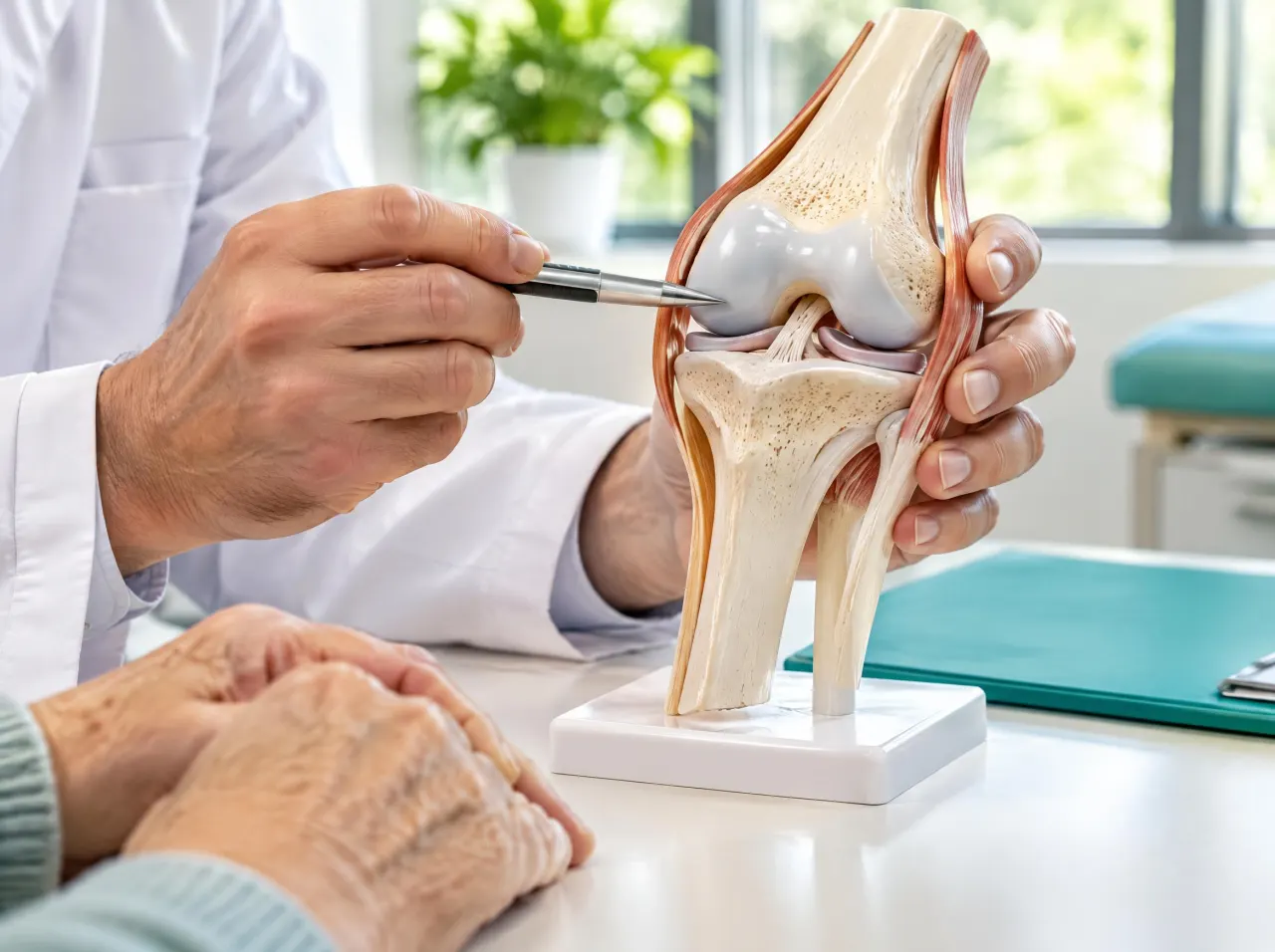
What is partial knee replacement?
The knee joint is made up of three parts (compartments): the inner half, the outer half and the joint between the kneecap and the knee. When only the inner or the outer half of the joint is worn, resurfacing that area with an implant is called partial knee replacement. It is also popularly known as a “half knee replacement”.
Why does only one part of the knee wear out?
In the early stage of osteoarthritis, only one part of the knee may be worn. When the legs are misshapen, too, only the inner or the outer half of the joint wears away. Because inward bowing of the legs (bow legs) is more common in our population, it is mostly the inner half of the knee that wears out. In patients with knock knees, on the other hand, the outer half wears out early.
How does it differ from total knee replacement?
In partial knee replacement, only the worn part of the knee is operated on; the other half and the cruciate ligaments in the middle are left untouched.
- It is performed through a smaller incision
- Less bone is cut
- There is less blood loss
- There is less pain after the operation
- Recovery time is shorter because movement is regained earlier
- The knee feels more normal because the cruciate ligaments are not cut
- The range of knee bending is generally greater
Why is robotic surgery even more important in partial replacement?
Because the other half of the knee is intact, the knee does not tolerate positioning errors made in a partial knee replacement. This is why good surgical technique is so important for the implant to last a long time. Robotic systems were developed to eliminate this problem: with the robotic arm system that we use, the implant is positioned according to a plan prepared from the CT scan.
Who is it suitable for?
Patients aged 50–60 in the early stage of joint wear, or older patients in whom only the inner part of the joint is worn, are suitable candidates for partial knee replacement.
Don't leave it too late: In knees with partial wear together with a deformity of the leg, if surgery is delayed the healthy part of the knee also wears out quickly and the chance of a partial replacement is lost. In that case a total knee replacement is needed.
How is the decision for partial knee replacement made?
Patients who come to us with symptoms of osteoarthritis are assessed by examination and X-ray. If necessary, X-rays in different positions or an MRI scan are requested to confirm that the other part of the knee is intact. The final decision is made during the operation: it is confirmed by looking at the rest of the knee through the incision. If, in rare cases, the other part is also found to be damaged, the incision can be extended by about 2 cm and a total knee replacement performed instead.
What are the risks?
- Infection: The rate is lower than with total knee replacement, at below 1%.
- Dislocation: This can occur with partial replacements that have a mobile bearing surface.
- Early wear: This can develop depending on how the knee is used or on the surgical technique.
- Pain and stiffness in the knee: If the stiffness persists and the pain increases, conversion to a total replacement may be necessary.
- Fracture, dislocation of the kneecap, blood clot formation in the leg, and injuries to blood vessels, nerves and ligaments.
Frequently asked questions
When will I be on my feet after a partial knee replacement?
Patients can get up the day after the operation, walk with their full weight on the leg and take short walks with a hand-held support.
When will I be discharged from hospital?
Patients are discharged home after 3 days on average.
How long does a partial knee replacement last?
Thanks to modern designs and good surgical technique, the 10-year survival rate of partial knee replacements has reached around 90%.
Can I take part in sport after a partial knee replacement?
You can take part in sports that do not involve sudden twisting and jumping, such as swimming, cycling, golf and bowling. Competitive sports and sports that involve jumping are not recommended.
When can I go back to work, and when can I drive?
Office workers can return to work after about 6 weeks. Driving may also be permitted 6 weeks after the operation; what matters is having enough strength in the leg to press the pedal if you need to stop suddenly.
 This page was prepared by Prof. Dr. Levent Altınel. The information is for general guidance only; it is no substitute for an examination and diagnosis.