
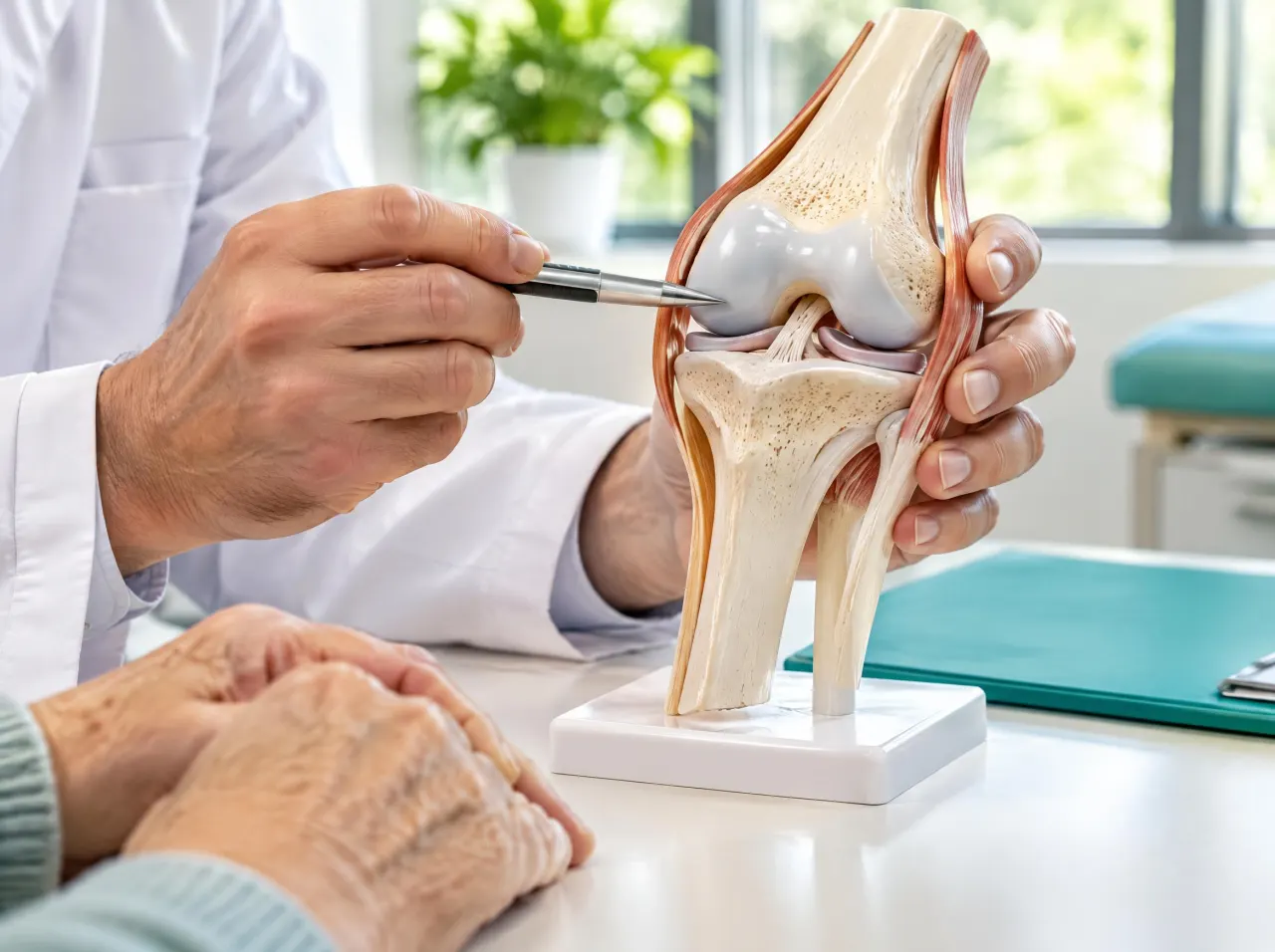
What is knee osteoarthritis?
When the cartilage covering the surface of the knee joint breaks down, the damaged surfaces rub against each other, causing pain, swelling, noises from the joint and, over time, deformity and restricted movement. This condition is called osteoarthritis of the knee joint (often described as “wear and tear” of the knee; the medical term is gonarthrosis). It is seen mostly in middle and older age and is common in women.
What are the symptoms?
- Pain that is intermittent and mild at first increases over time and becomes constant; there may be pain that keeps you awake at night.
- Swelling and fluid on the knee appear, at first after activity and, as the condition progresses, even at rest.
- Clicking and clunking noises with knee movement become increasingly noticeable.
- The knee bends less and cannot be straightened fully.
- The legs usually develop an inward bend known as “bow legs”.
- Squatting and putting on socks become difficult; because the distance you can walk gets shorter, you no longer want to leave the house.
What are the causes?
Advancing age, a family tendency, excess weight, overuse, falls and previous accidents, rheumatic diseases, joint infections, conditions that impair the blood supply to the bone, bone cysts and tumours, and repeated surgical procedures can all lead to osteoarthritis.
Non-surgical treatments
While the osteoarthritis is mild, the aim is to delay the deterioration of the joint and reduce pain.
Weight control and exercise
Excess weight increases the load on the knee joint. The main goal of a personalised diet plan is to reach a normal body weight. Physiotherapy helps to strengthen the muscles around the knee and reduce pain.
Medicines and supports
Painkillers ease the symptoms. Supplements such as glucosamine and collagen may be used in mild osteoarthritis. Knee supports and insoles may ease pain by slightly reducing the load on the joint, but they do not prevent osteoarthritis.
Injections into the joint
An injection of artificial joint fluid (viscosupplementation) provides a kind of lubrication on the worn joint surface, reducing friction; it can provide relief for around 4–6 months.
Joint-preserving operations
Bone operations that correct the shape of the leg and keyhole (arthroscopic) knee operations can prevent deterioration of the joint in suitable patients.
When is a replacement needed?
In advanced osteoarthritis the cartilage is completely damaged and comfort in daily life is seriously reduced. In this situation, the way to restore quality of life is to resurface the damaged joint surfaces, in other words joint replacement surgery. If only one half of the knee is worn, a partial knee replacement may be sufficient.
Positioning an implant of a size that suits the joint at the correct angles, and adjusting the ligament balance well, determine the success of the operation. This is exactly what robotic surgery provides.
Frequently asked questions
What is knee osteoarthritis?
It is the development of pain, swelling, noises from the joint and, over time, deformity and restricted movement, as a result of the cartilage covering the surface of the knee joint breaking down and the damaged surfaces rubbing against each other.
Can knee osteoarthritis get better without surgery?
At mild stages, the deterioration of the joint can be delayed with weight loss, painkillers, physiotherapy and injections into the joint. At an advanced stage, when the cartilage is completely damaged, the way to restore quality of life is joint replacement surgery.
How effective are knee injections (artificial joint fluid)?
Injections into the joint provide a kind of lubrication on the joint surface where the cartilage has worn away, reducing friction. They can provide relief for around 4–6 months.
 This page was prepared by Prof. Dr. Levent Altınel. The information is for general guidance only; it is no substitute for an examination and diagnosis.